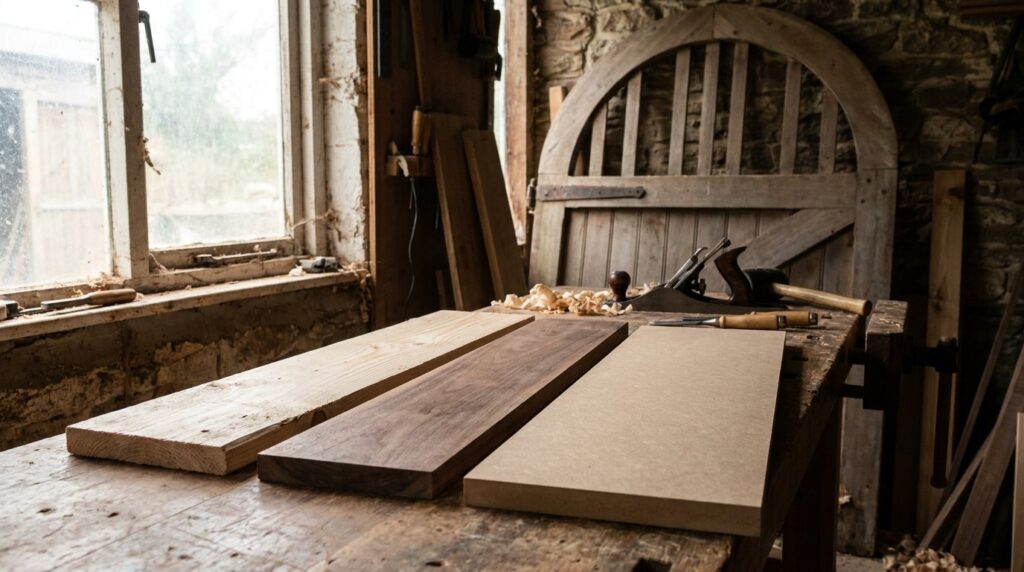
When you move into a house you plan to stay in for decades, decisions change. A cheap fix that lasts a few years is fine in a rental or a first flat, but in a forever home you will be living with the consequences of every choice for a long time. That is especially true outside, where gates, garage doors and garden doors face rain, frost and summer sun year after year. The type of timber you choose makes a bigger difference than most people expect.
Why timber choice matters outdoors
Wood is a natural material that moves. It takes on moisture in wet weather and dries out in warm spells, swelling and shrinking as it does. Over time, that movement can open joints, crack paint and let water into the grain, which is where rot begins. A gate that sticks every winter or a garage door that won’t close properly usually comes down to the timber and how well it has been protected.
The three main options
Softwood
Softwoods such as redwood are the most economical choice and are widely used for gates and doors. They are easy to work, take paint and stain well, and perform perfectly well when they are properly treated and maintained. The trade-off is upkeep: they need regular attention to stay in good condition.
Hardwood
Hardwoods are denser and naturally more durable. They cost more, but many people love the way they weather and mature. With maintenance, a good hardwood gate can stay in service for a very long time.
Accoya
Accoya is a modified wood, treated to make it far more stable and resistant to rot than ordinary timber. It is designed to stay dimensionally steady, so doors and gates are less likely to swell, shrink or twist with the seasons.
What one gate maker says about lifespan
A34 Timber Gates & Garage Doors, a family-run maker in Penkridge, Staffordshire, builds gates in all three materials, and its guidance gives a useful comparison. According to its FAQ, softwood gates might last between seven and ten years depending on maintenance, hardwood gates 30 to 35 years with maintenance, and Accoya gates up to 50 years. It describes Accoya as highly rot-resistant and notes that the timber comes with a manufacturer’s warranty of 50 years above ground.
Its range of Accoya gates and doors includes arched and swan neck driveway gates, estate gates, an arched side gate, Victorian-style garage doors and narrowboat doors. For homeowners who don’t want to replace the same gate twice, that kind of longevity is worth weighing against the higher initial cost.
Thinking about cost over time
Comparing timbers on the price of the gate alone can be misleading. A fair comparison includes:
- how often the timber needs repainting or re-staining, and the cost of doing it;
- the likely lifespan before replacement;
- the cost and disruption of taking down and refitting a gate or door;
- how much the timber’s appearance matters to you as it ages.
In a house you only expect to live in for a few years, softwood may be the obvious answer. In a home you hope to keep until retirement, the maths can look very different. It is also worth remembering how busy the first years in a new home can be, with decorating, repairs and garden projects all competing for weekends. A gate that asks less of you leaves more time for everything else.
Looking after whatever you choose
- Seal or paint all faces of new timber, including the edges and bottom, as soon as possible.
- Keep soil, leaves and plants away from the foot of gates and doors.
- Check hinges and fixings once a year and tighten anything that has worked loose.
- Touch up damaged paint before water can get in.
Settling into a forever home is the perfect moment to think long term. Choosing the right timber for your gates and outdoor doors means fewer repairs, less maintenance and a frontage that still looks good when the moving boxes are a distant memory.